Household wastewater that is not collected by a public sewer - i.e. the contents of septic tanks and closed cesspools - requires regular emptying. This is not only amenities, but legal obligation which applies to any property which not connected to the public sewer.
In the municipalities, the service is provided on the basis of the municipal ordinance only licensed sniffing service providers can be done by. Our company is fully licensed to carry out these activities.
The following guide explains, when to ask for a sniff, how the process works, and what to look out for as a retail customer, to ensure that everything is done properly, quickly and safely.
1. When is it necessary to siphon waste water?
In the following cases mandatory or strongly recommended:
1) If the derating or closed container fills up
This is the most common reason. Overflow is a serious public health poses a risk.
2) If there is an unpleasant smell in the garden or around the house
This is often caused by too much fluid or a lack of ventilation.
3) If drains are slow to drain
If the house system is in order but the septic tank is full, the water cannot drain away.
4) When buying a new property, before moving
Many people take over a property without knowing when the last time the drain was emptied.
2. How does the sniffing process work? - Step by step
The process is simple, quick and completely safe if you licensed service provider will be carried out by.
Step 1 Agreeing on a date
The resident indicates the need and the service provider agrees:
- the address details
- the type and access to the container
- the expected quantity
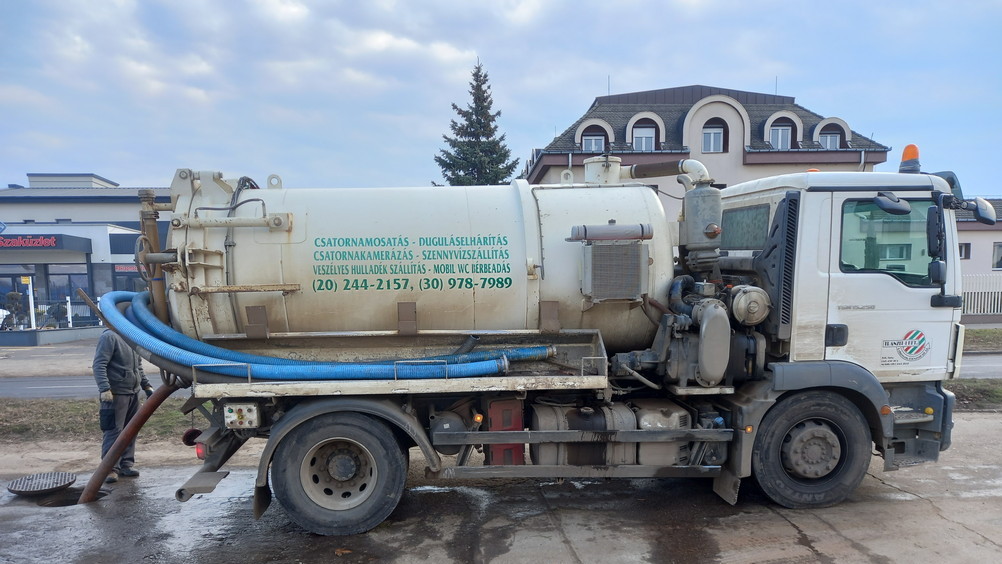
Step 2 Arrival by special suction vehicle
Tranzit-1 Ltd. is modern and environmentally compliant.
Step 3 Open the container and check the liquid level
Colleagues will assess the situation and, if necessary, check ventilation, pipe drainage and possible leaks.
Step 4 Pumping out the waste water
Modern sniffer technology:
- fast
- odour-free
- environmentally friendly
The process takes from a few minutes to half an hour, depending on local conditions and the amount to be sniffed.
Step 5 Close the container, restore the environment
No dirt, mud or water is left behind.
Step 6 Transport the wastewater to the prescribed disposal site
This is a mandatory element, strictly regulated by the Regulation.
Step 7 Delivery of documentation to the resident
The service provider must provide a certificate of the sniffing.
3. What should I look out for as a retail customer? 5 important points
1. Always choose a licensed service provider
Sniffing could be done illegally, but it is:
- causes serious damage to the environment
- may have legal consequences
- poses a risk of infection
Tranzit-1 Ltd. has all the necessary permits.
2. Check the provider's eligibility for municipal status
Debrecen area of the service officially designated companies can do.
The Municipality of the City of Debrecen a joint consortium of Tranzit-1 Kft. and Turmix Bt. the task:
- collection of non-publicly collected household waste water
- transport
- disposal
This task is carried out on the basis of the following regulations:
- Municipal Decree 66/2012 (XII.13.)
- Municipal Decree 47/2022 (XII.15.)
3. The waste water storage facility should be easily accessible
For the vehicle in general:
- 1,5-2 m side access lane
- cover page availability
- stable soil
needed.
4. Don't wait until it overflows
Overflow is dangerous:
- can spread infections
- can cause soil contamination
- may result in a fine
5. Keep the sniffing documents
These show that you have complied with the legal obligation.
4. How much does it cost to siphon wastewater? (General information)
The fees are fixed per municipality those laid down in the municipal decree, and depend on the following:
- delivery charge
- volume of waste water (m³)
- emptying and disposal charges
- possible recovery conditions
The awards not determined by the provider, but is regulated by the city's ordinance.
This is guaranteed for residents:
- transparency
- predictability
- the uniform tariff